How to Complete a Quran Khatma in 30 Days: Daily Plan (Khatm, Khitma)
A khatma (also spelled khatm or khitma) is a complete reading of the Quran, from the first surah to the last. Many Muslims do one during Ramadan, but you can start one at any time of the year. The good news: with a simple plan, finishing the Quran in 30 days is within reach of someone with a normal life.
In this article you'll find a day-by-day plan, two gentler versions (60 and 90 days), and tips to keep going to the end.
1. Khatma or hifz: what's the difference?
- A khatma means reading the whole Quran, following the text.
- Hifz means memorizing the whole Quran. See what is a hafiz and how do you become one?.
They complement each other: a regular khatma keeps you connected to the text, and it is often a good first step before starting memorization.
2. The Quran in numbers
- 114 surahs and 30 juz (parts of roughly equal size)
- About 604 pages in the Madinah mushaf, the most widespread (the count can vary slightly by edition)
3. The plan: one juz a day
A juz is about 20 pages. A simple way to spread it over the day is to read 4 pages after each of the 5 prayers: 5 × 4 = 20 pages.
| Day | Reading |
|---|---|
| 1 | Juz 1 |
| 2 | Juz 2 |
| 3 | Juz 3 |
| … | … |
| 29 | Juz 29 |
| 30 | Juz 30 |
Depending on your reading speed, a juz can take roughly 30 minutes to an hour, as a rough guide. If you read slowly or are a beginner in Arabic, pick one of the plans below instead.
4. If 30 days is too much: 60 and 90-day plans
| Duration | Pace | Split |
|---|---|---|
| 30 days | 20 pages a day (1 juz) | 4 pages after each prayer |
| 60 days | 10 pages a day (½ juz) | 2 pages after each prayer |
| 90 days | about 7 pages a day | about 1 to 2 pages after each prayer |
A 90-day khatma you keep up beats a 30-day khatma abandoned after a week.
5. Ten tips to keep going
- Pick your moment: after each prayer is easiest, because the habit is already there.
- Always use the same mushaf, so pages are in the same place.
- Read out loud if you can: you stay more focused.
- Plan a catch-up day each week in case you fall behind.
- Don't judge yourself if you miss a day: pick up the next day.
- Track your progress on a calendar; ticking off each juz is motivating.
- Do it with others (family or a friend) to encourage each other.
- Prepare for tired evenings by saving the shorter pages for then.
- Start on a day when you have time, not the eve of a busy week.
- If you can't read Arabic well yet, start by learning to read (French: learn to read Arabic as a beginner).
6. Doing a khatma during Ramadan
Ramadan lasts about 30 days: one juz a day fits perfectly. To make the most of it, start your habit a few weeks before, so you arrive with the rhythm already in place.
7. From reading to memorizing
When you read the Quran every day, the wish to retain certain passages often comes up. QuranMemorize can support you with:
- Consistency tracking and streaks, useful for keeping a daily habit
- Arabic reading and tajweed modules to read with more confidence
- Prepared review sessions once you start to learn surahs by heart
To choose your first ones, try how to learn Surah Al-Fatiha, or read Become a Hafiz: the complete guide.
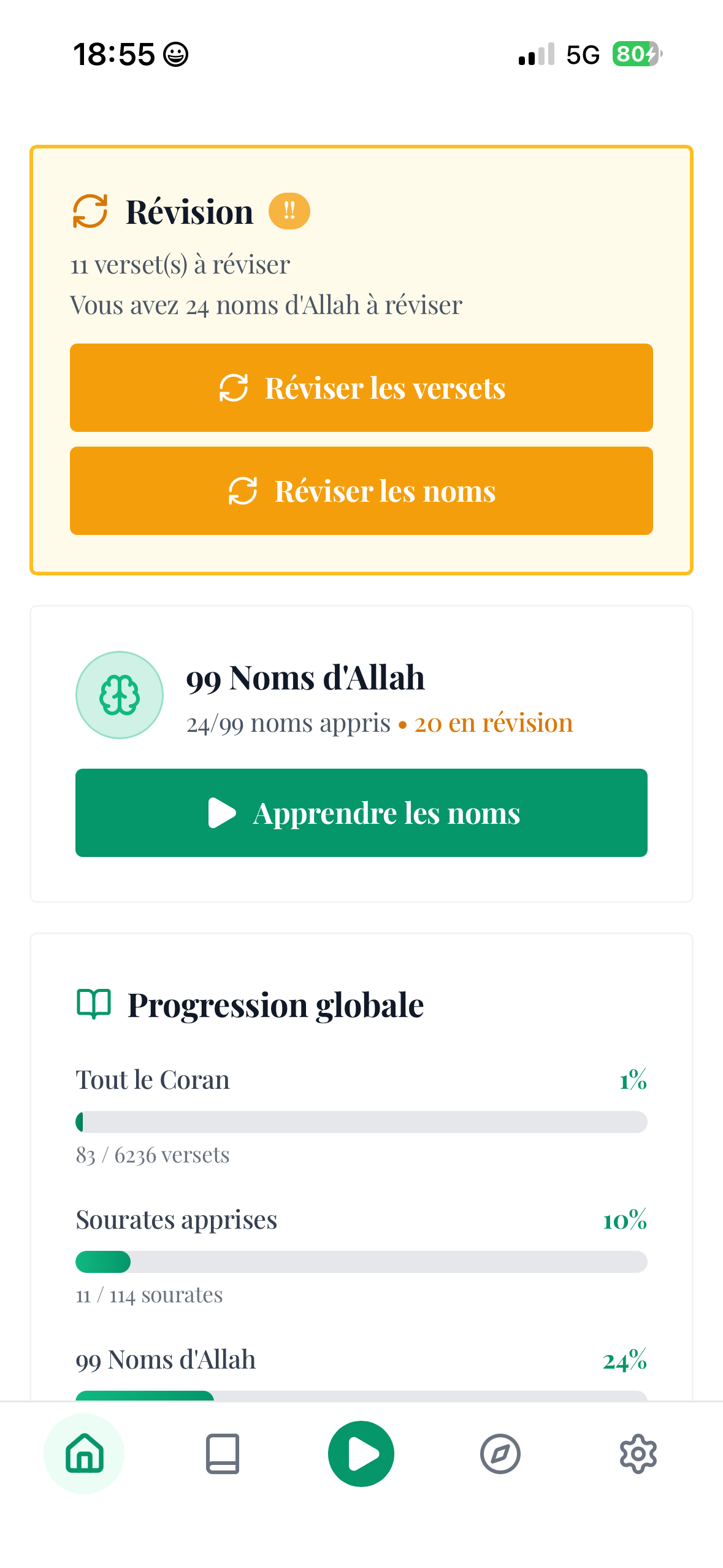
From reading to memorizing
QuranMemorize supports your daily consistency.
8. Frequently asked questions
How long does it take to complete a khatma?
It depends on your pace: 30 days at 20 pages a day, 60 days at 10 pages, 90 days at about 7 pages.
Does a khatma have to be done during Ramadan?
No, you can do one at any time of the year. Ramadan is simply a period when many people do.
Can I do a khatma without understanding Arabic?
Yes, you can read the Quran without understanding every word, and reading a translation of the meaning alongside is possible.
What if I miss a day?
Pick up the next day without getting discouraged. That's why a catch-up day in the week helps.
What's the difference between khatma and hifz?
A khatma is a complete reading; hifz is complete memorization.
9. Summary
A 30-day khatma boils down to one juz a day, or 4 pages after each prayer. If that's too much, 60 or 90 days work just as well. What matters is choosing a pace you can sustain, and starting.