The Essential Tajweed Rules for Reciting the Quran Correctly
The foundations to learn in order to pronounce letters correctly and steadily improve your recitation.
Tajweed is the set of rules that allow you to correctly pronounce the letters and words of the Quran, as they were transmitted. Many beginners think they need to first read Arabic fluently before looking into it. In reality, learning the basics of tajweed alongside reading helps avoid picking up bad habits from the start.
1. What is the science of tajwid?
Tajwid comes from an Arabic root meaning to improve or perfect. It refers to the art of properly articulating every letter of the Quran with its own characteristics, in order to respect the text as it was transmitted. It isn't just a matter of aesthetics: mispronunciation can change the meaning of a word.
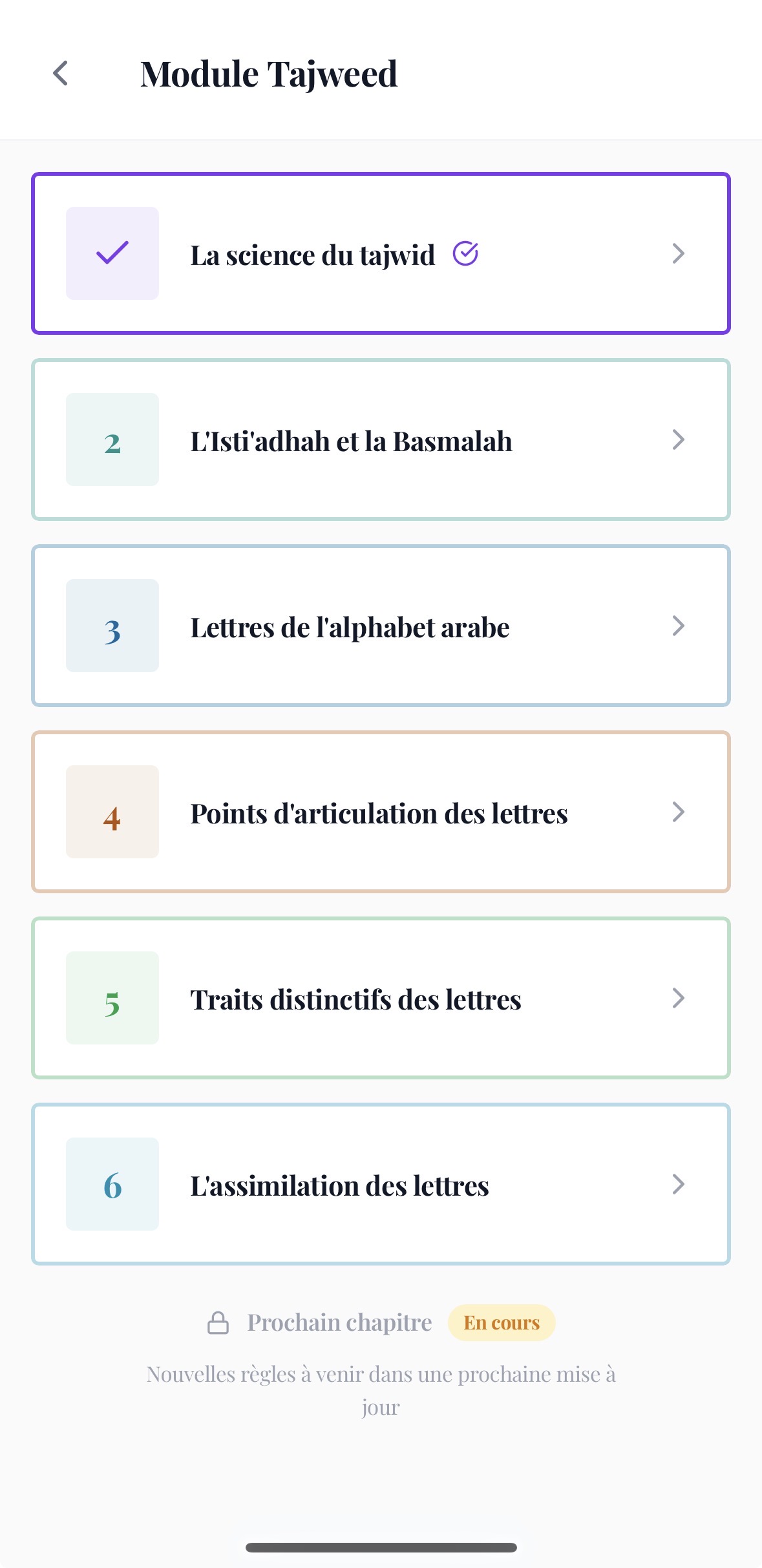
The Tajweed module in QuranMemorize starts with these basics before moving into the concrete rules.
2. The Isti'adhah and the Basmalah
Before starting the recitation of a surah, two ritual formulas apply: the Isti'adhah, the formula of protection, and the Basmalah, "In the name of Allah." Knowing when and how to recite them correctly is one of the basics often overlooked by beginners.
3. The letters of the Arabic alphabet
Every letter has a precise pronunciation. In particular, you need to learn to distinguish letters that sound similar to a non-native speaker, such as ص and س or ق and ك. This is a key step for faithful recitation, not just for deciphering the text.
4. The articulation points of the letters
Every Arabic letter comes from a precise place in the mouth or throat: the makhraj. A letter articulated from the wrong point can be confused with another.
5. The distinctive traits of the letters
Beyond knowing where each letter comes from, you also need to know how it comes out. Some letters are heavy, others light, some are breathy. These characteristics refine pronunciation and differentiate phonetically similar letters.
6. The assimilation of letters
When certain letters follow one another, they assimilate according to precise rules, such as idgham. This changes how they're pronounced out loud compared to how they're written, and explains why an experienced qari's recitation sounds different from a letter-by-letter reading.
7. How to progress without feeling overwhelmed
These six notions represent a lot of information. The right approach isn't to memorize everything in one session, but to progress gradually with regular reminders.
That's the approach of the Tajweed module in QuranMemorize: each chapter unlocks progressively, with a review system that brings back notions already seen. Combined with the Arabic reading and Quran memorization modules, this helps build a solid foundation step by step.
8. In summary
Tajweed isn't reserved for advanced reciters. Learning its basics from the start avoids having to unlearn bad habits later. It's better to move slowly with the right foundations than to rush and accumulate pronunciation errors.
Learn tajweed with QuranMemorize
Progress step by step with the reading and recitation modules.