How to Make Dua (Duaa, Duaas, Supplication): A Guide with Steps and Examples
Dua, duaa, du'a, invocation or supplication: simple steps to call upon Allah sincerely.
Making dua means calling on Allah: speaking to Him, asking Him, thanking Him. The word is spelled in several ways in English (dua, duaa, du'a, doua), and the plural is duas or duaas; it is also translated as supplication or invocation. Everyone makes dua, but many wonder whether they are doing it « properly ». Here is a simple guide: the steps, the best times, what helps, and examples of duas from the Quran.
1. What is a dua?
A dua (دعاء) is a supplication addressed to Allah, in words you choose or words you learn from the Quran and the Sunnah. It is part of worship: Allah says in the Quran, in essence, “Call upon Me, I will respond to you” (Surah Ghafir, verse 60). He also says He is near and responds to the one who calls on Him (Surah Al-Baqarah, verse 186).
Dhikr remembers and glorifies Allah; dua asks. The two complement each other.
2. The steps to make a dua
- Begin with sincerity, with your heart present.
- Praise Allah at the start.
- Send blessings on the Prophet ﷺ before asking.
- Make your request clearly, with confidence and hope.
- Raise your hands if you can.
- End with praise, salawat and “ameen”.
- Be patient and keep asking.
These steps are an aid, not a condition: every sincere dua has value.
3. Can I make dua in my own language?
Yes. Outside prayer, you can make dua in English or in whatever language you understand best. What matters is that your heart is present. Learning Quranic duas in Arabic is a beautiful addition, but it is not a condition.
4. The best times to make dua
- In prostration (sujud): Muslim reports that the servant is closest to his Lord when prostrating, and that supplications should be increased there.
- The last third of the night, a time many Muslims seek out.
- Between the adhan and the iqamah: a hadith reported by Abu Dawud and At-Tirmidhi, among others, says that dua is not rejected at that time.
- While fasting and at the time of breaking the fast.
- The Day of Arafah, for those on pilgrimage, and for others, during that day.
- Friday, when some scholars mention an hour of acceptance, with differing opinions on the exact time.
Always check exact references and authenticity with a reliable source or scholar.
4. What helps, and what gets in the way
What helps
- Sincerity and a present heart.
- Persistence: repeating the same dua rather than making it once.
- Lawful food and earnings: a hadith reported by Muslim stresses their importance for acceptance.
- Asking for good for yourself and for others.
What gets in the way
- Haste and giving up.
- Asking for harm or something forbidden.
- A distracted heart.
6. What does « my dua was not answered » mean?
A hadith reported by Ahmad, among others, says that a sincere dua is answered in one of three ways: Allah grants what was asked, removes an equivalent harm, or stores the reward for the Hereafter. Check the authenticity of this hadith with a reliable source. No sincere dua is lost, even when the answer does not look like what you expected.
7. Quranic duas to know
| For what | Dua | Source |
|---|---|---|
| Good in this world and the next | Rabbana atina fi ad-dunya hasanatan wa fi al-akhirati hasanatan wa qina adhaba an-nar | Al-Baqarah, 201 |
| Increasing in knowledge | Rabbi zidni ilman | Ta-Ha, 114 |
| Keeping a firm heart | Rabbana la tuzigh qulubana bada idh hadaytana wa hab lana min ladunka rahmah, innaka antal-Wahhab | Al-Imran, 8 |
| Easing a task | Rabbi ishrah li sadri wa yassir li amri | Ta-Ha, 25-26 |
| Asking forgiveness | Rabbana zalamna anfusana wa in lam taghfir lana wa tarhamna lanakunanna min al-khasirin | Al-A'raf, 23 |
6. Learning duas by heart
- Pick 5 duas that speak to you.
- Learn one a week.
- Understand the meaning of every word.
- Review them at progressive intervals so you don't lose them: the next day, a few days later, then one or two weeks later. See Become a Hafiz: the complete guide.
QuranMemorize prepares a daily review session, tracks progress and helps you stay consistent. If you are a beginner, start with how to learn Surah Al-Fatiha or Ayat al-Kursi, often recited after prayer.
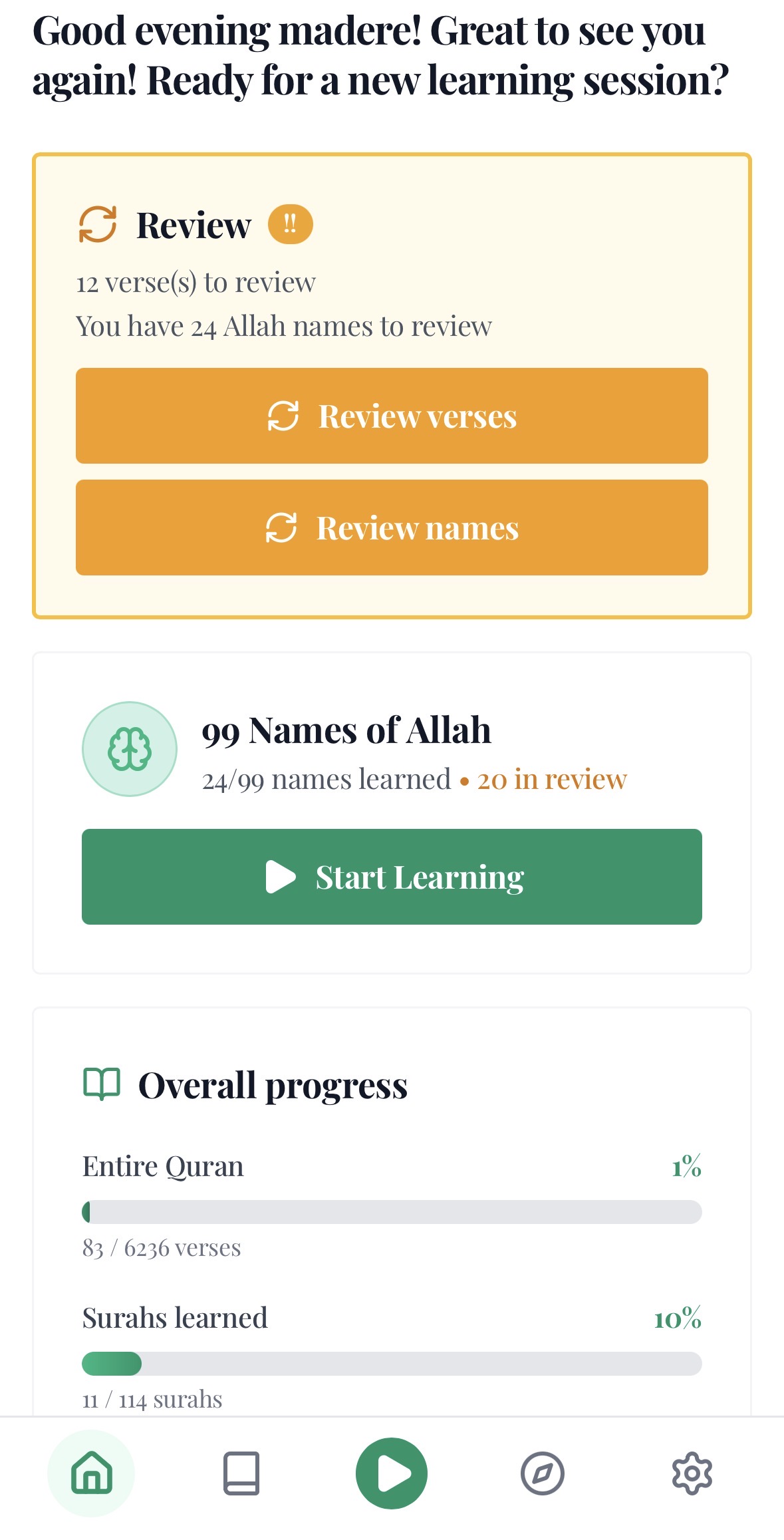
Learn duas with QuranMemorize
Memorize Quranic supplications and review them regularly.
7. Frequently asked questions
How do you spell “dua”?
Dua, duaa, du'a and doua are all used; the common plural is “duas”.
Do I have to raise my hands to make dua?
It is a practice reported in several hadiths and recommended, but you can also make dua without raising your hands.
Can I make dua in English?
Yes, outside prayer. What matters is understanding what you ask.
Do I need to be in a state of purity?
It is not a condition, although many prefer it out of respect.
What is the difference between dua and dhikr?
Dhikr remembers and glorifies Allah; dua asks Allah for something.
Summary
Making dua is simple: a sincere heart, words of praise, salawat, your request with confidence, then patience. Learning Quranic duas by heart lets you carry them with you.